Product images · Packaging may change
Lamb Kabob Meat
100% grass-fed non-GMO.
Feed
100% grass-fed non-GMOCertifications
G.A.P. Animal Welfare Certified — Step 4, Non-GMO Project VerifiedOrigin
New ZealandA CLOSER LOOK
The food facts.
Positives
Product information
Origin & producer
Related businesses
Country of origin · New Zealand
New Zealand
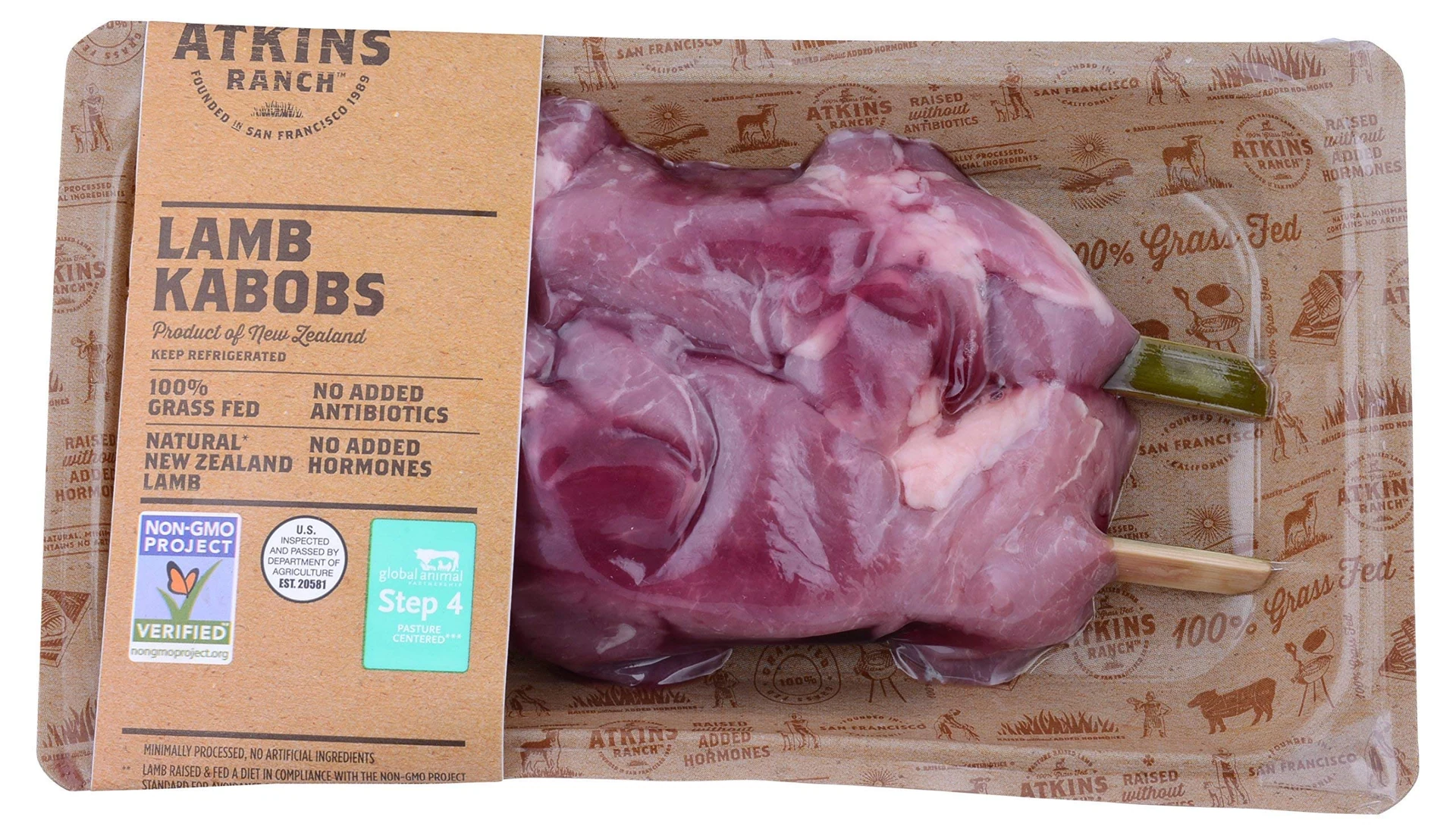
Pictured processing site · Pictured: Atkins Fremont, California — EST. 20581
The retailer’s undated Atkins Ranch package image shows New Zealand origin and EST. 20581, matched to Atkins’ Fremont, California processing site. The mark identifies U.S. processing, not the New Zealand slaughter plant or every current lot.
Separates New Zealand meat origin from U.S. further processing. The package does not identify a specific farm or New Zealand slaughter site.
Supplier network context does not allocate this package to any named ranch.
Sources
- Exact Atkins lamb kabob package image
- USDA FSIS establishment directory — December 2, 2014 · Printed p491; historical operator/site identity, corroborated by retained September2026 directory review
Named supplier examples · Supplier examples: Awapai Horizon Kinburn Kouratahi Rangitoto Glen Eden
Atkins’ named supplier network includes Awapai, Horizon Farming, Kouratahi, Kinburn, Rangitoto and Glen Eden. These are supplier examples, not a farm allocation for this package.
Programme requirements or supplier-network context, not an individual farm or current shipment observation.
Sources
Feed
Whole Foods Meat standards
Whole Foods’ Meat-department standards exclude animal by-products in feed. Its processing standards also prohibit irradiation, meat glue and lean finely textured beef.
Retailer department eligibility, not a farm feed log or complete processing-aid inventory.
Sources
Organic certification · Not organic certified
Not organic certified. Grass-fed, non-GMO and animal-welfare claims cover separate requirements.
Programme requirements or supplier-network context, not an individual farm or current shipment observation.
How it's raised
Conditions · Pasture-raised
Pasture-raised
Slaughter welfare requirements · Pre-slaughter stunning and third-party welfare audits required
G.A.P.’s v1.4 sheep standard requires stunning before slaughter and a current third-party slaughter-welfare audit. This is the certification requirement; this lamb’s actual plant, stunning method and audit result are unassigned.
Adds actual certification requirements without an administered drug, residue, health conclusion, slaughter-method allocation or new quality rating.
Source version is May 2020; no current farm treatment record or individual slaughter audit was obtained.
Sources
- G.A.P. meat-sheep standard v1.4 · 8.1–8.2; printed p42
Animal transport limit · 18-hour transport cap; collection-point waits excluded
G.A.P.’s v1.4 sheep standard caps Step 4 market-sheep transport at 18 hours. Loading, unloading and waiting at collection points are excluded from that calculation. This is a programme limit, not the actual journey time.
Programme duration calculation, not an 18-hour cap on every part of the total animal journey or this shipment’s measured travel.
Actual loading, holding and travel records remain unassigned.
Sources
- G.A.P. sheep v1.4 transport duration · Section6.6, printed p37
Step 4 procedure rules · Castration and tail docking permitted under limits
G.A.P. sheep v1.4 Step 4 permits castration and tail docking under age and method limits, while prohibiting mulesing. Pain relief for routine young-lamb castration is encouraged. Actual flock procedures are unconfirmed.
Programme permission is useful when comparing standards; it does not prove that these lambs underwent a procedure or establish a new product rating.
Older-age procedure exceptions require a veterinarian and specified anaesthetic/analgesia.
Sources
- G.A.P. sheep v1.4 procedure rules · Printed pages 19–20; sections 2.4, 2.6 and 2.9; Step 4 columns
Outdoor access · Year-round outdoor access with severe-weather shelter
Year-round outdoor access without seasonal confinement, with severe-weather shelter under the Atkins lamb programme.
Programme requirements or supplier-network context, not an individual farm or current shipment observation.
Sources
Pre-transport requirements · Fitness checks declarations and four-hour pre-trucking emptying
Supplier requirements: fit-to-travel checks, a pre-arrival Animal Status Declaration and at least four hours to empty out before trucking.
Programme requirements or supplier-network context, not an individual farm or current shipment observation.
Antibiotics & hormones
No antibiotics
Excellent
No antibiotics
Routine antibiotic use can select for resistant bacteria. A no-antibiotics supply commitment keeps treated animals out of that programme; sick animals still need care.
Raised without antibiotics. Limiting routine antibiotic use helps reduce selection for antibiotic-resistant bacteria. Sick animals can still receive care and be kept out of this supply.
No added hormones
Excellent
No added hormones
Added growth hormones accelerate weight gain. We would choose meat raised without that intervention.
A no-added-hormones commitment excludes hormone treatments used to accelerate weight gain.
Parasite-control rules · Parasite treatments allowed; organophosphates excluded
G.A.P.’s v1.4 sheep standard allows parasite treatments and vaccines, require treatment records and exclude organophosphates. Synthetic pyrethroids are listed as acceptable alternatives. These are programme permissions, not this lamb’s medicine record.
Adds actual certification requirements without an administered drug, residue, health conclusion, slaughter-method allocation or new quality rating.
Source version is May 2020; no current farm treatment record or individual slaughter audit was obtained.
Sources
- G.A.P. meat-sheep standard v1.4 · 1.2–1.3; printed pp13–15
Certifications
Certifications · G.A.P. Animal Welfare Certified — Step 4, Non-GMO Project Verified
G.A.P. Animal Welfare Certified — Step 4, Non-GMO Project Verified
An unknown answer does not mean “none.” Check your package for current details.
KEEP EXPLORING