Portoro Australian Ribeye MB4+
Portoro Australian ribeye. Grain-finished non-GMO feed. MB4+ marbling.
Finishing conditions
Feedlot-finishedFeed
Grain-finishedFeed
Non-GMO feedCertifications
JBS Farm Assurance, Certified Grain FedOrigin
AustraliaA CLOSER LOOK
The food facts.
Negatives
Finishing conditionsFeedlot-finishedBad
Portoro’s Yambinya operation combines open paddocks and feedlot pens across 8,000 acres. The beef is grain-finished.
More info
Bad
Portoro’s Yambinya operation combines open paddocks and feedlot pens across 8,000 acres. The beef is grain-finished.
JBS describes actual cattle across feedlotpens/openpaddocks at its8000acreYambinyafarm and explicitly links PortoroNaturalgrainprogramme. Producer yearroundgrazingseason is not yearround pastureaccess for every animal.
Feedlot finishing concentrates animals in pens around supplied feed, limiting their freedom to graze and range. The placement is Bad whether the finishing ration contains grass, grain or both.
No exact animal/pen allocation, pasture duration, stocking density or independent welfare audit established.
Sources
Paddocks and feedlot pens
Portoro’s Yambinya operation combines open paddocks and feedlot pens across an 8,000-acre property. This is grain-finished beef; exact pasture and pen durations for this package remain unconfirmed.
JBS describes actual cattle across feedlotpens/openpaddocks at its8000acreYambinyafarm and explicitly links PortoroNaturalgrainprogramme. Producer yearroundgrazingseason is not yearround pastureaccess for every animal.
No exact animal/pen allocation, pasture duration, stocking density or independent welfare audit established.
FeedGrain-finishedMediocre
Grain finished on non-GMO feed, with gradual feed acclimation. May 2024 programme reporting described about 130 days on feed; that is dated context, not a fixed duration for this package.
More info
Mediocre
Grain finished on non-GMO feed, with gradual feed acclimation. May 2024 programme reporting described about 130 days on feed; that is dated context, not a fixed duration for this package.
A lifetime forage diet excludes grain, including during finishing. Grass-fed beef generally has more omega-3 fat and a lower omega-6 to omega-3 ratio than grain-fed beef.
The brand establishes grain feeding and non-GMO feed. The dated industry report supplies a useful historical duration, separate from a current specification.
Grain finishing supplies energy-dense feed for weight gain and marbling before slaughter. We would choose grass and forage for cattle. In beef comparisons, forage feeding generally produces more omega-3 fat and a lower omega-6 to omega-3 ratio.
The current package’s ration ingredients, proportions and finishing duration remain unconfirmed. Historical study ration context is shown separately.
Portoro historical ration — 2020–23
A 2026 programme study reports a barley-led Portoro ration for 2020–23, with canola, hay, straw, silage, hulls and molasses. This is historical study data, not the current recipe for this package.
The recovered original supplement supplies actual historical programme ingredient context. Its listed percentages total 101% despite a printed 100% total, so no corrected percentage recipe or current formula is assigned. The paper is industry-funded carbon modelling, not a nutrition or meat-safety trial.
Canola form, hull species and unspecified other ingredients remain unresolved.
The table’s arithmetic discrepancy is preserved; no normalisation or current ration proportions inferred.
Sources
- Portoro study supplementary tables — Table S7 · Supplementary PDF page 9; dataset covers 2020–23
- Published 2026 programme study
Positives
FeedNon-GMO feedGood
Grain finished on non-GMO feed, with gradual feed acclimation. May 2024 programme reporting described about 130 days on feed; that is dated context, not a fixed duration for this package.
More info
Good
Grain finished on non-GMO feed, with gradual feed acclimation. May 2024 programme reporting described about 130 days on feed; that is dated context, not a fixed duration for this package.
A non-GMO feed commitment excludes genetically engineered feed crops. It rules out those crops in the ration.
The brand establishes grain feeding and non-GMO feed. The dated industry report supplies a useful historical duration, separate from a current specification.
Non-GMO feed excludes genetically engineered crops from the ration.
The current package’s ration ingredients, proportions and finishing duration remain unconfirmed. Historical study ration context is shown separately.
Portoro historical ration — 2020–23
A 2026 programme study reports a barley-led Portoro ration for 2020–23, with canola, hay, straw, silage, hulls and molasses. This is historical study data, not the current recipe for this package.
The recovered original supplement supplies actual historical programme ingredient context. Its listed percentages total 101% despite a printed 100% total, so no corrected percentage recipe or current formula is assigned. The paper is industry-funded carbon modelling, not a nutrition or meat-safety trial.
Canola form, hull species and unspecified other ingredients remain unresolved.
The table’s arithmetic discrepancy is preserved; no normalisation or current ration proportions inferred.
Sources
- Portoro study supplementary tables — Table S7 · Supplementary PDF page 9; dataset covers 2020–23
- Published 2026 programme study
Product information
Origin & producer
Related businesses
Country of origin · Australia
Australian beef under the Portoro programme; no individual birth farm is assigned.
Useful source-scoped context without assigning an individual farm, current plant or unobserved treatment.
Undated retail artwork does not establish every current lot.
Brand · Portoro
Portoro
Brand owner · JBS Australia
JBS Australia
Portoro production site · Yambinya Station, New South Wales
Yambinya Station near Burraboi, New South Wales, is Portoro’s published production site. Cattle can come from other grower farms; Yambinya is not established as this package’s birth farm.
A named programme production/finishing site is useful origin context. It does not identify the individual animal, birth farm, slaughter plant or retail lot.
Originating farms and this individual package’s custody remain unconfirmed.
Sources
British and European cattle
Portoro specifies British and European cattle. The exact breed composition for this package is not identified.
Useful source-scoped context without assigning an individual farm, current plant or unobserved treatment.
Undated retail artwork does not establish every current lot.
Sources
Programme processing locations · Scone, Brooklyn and Longford
Portoro lists Scone, New South Wales; Brooklyn, Victoria; and Longford, Tasmania as programme processing locations. No one plant is assigned to this package.
Useful source-scoped context without assigning an individual farm, current plant or unobserved treatment.
Undated retail artwork does not establish every current lot.
Sources
Feed
Portoro historical ration — 2020–23 · Barley-led ration reported for 2020–23
A 2026 programme study reports a barley-led Portoro ration for 2020–23, with canola, hay, straw, silage, hulls and molasses. This is historical study data, not the current recipe for this package.
The recovered original supplement supplies actual historical programme ingredient context. Its listed percentages total 101% despite a printed 100% total, so no corrected percentage recipe or current formula is assigned. The paper is industry-funded carbon modelling, not a nutrition or meat-safety trial.
Canola form, hull species and unspecified other ingredients remain unresolved.
The table’s arithmetic discrepancy is preserved; no normalisation or current ration proportions inferred.
Sources
- Portoro study supplementary tables — Table S7 · Supplementary PDF page 9; dataset covers 2020–23
- Published 2026 programme study
How it's raised
Paddocks and feedlot pens
Portoro’s Yambinya operation combines open paddocks and feedlot pens across an 8,000-acre property. This is grain-finished beef; exact pasture and pen durations for this package remain unconfirmed.
JBS describes actual cattle across feedlotpens/openpaddocks at its8000acreYambinyafarm and explicitly links PortoroNaturalgrainprogramme. Producer yearroundgrazingseason is not yearround pastureaccess for every animal.
No exact animal/pen allocation, pasture duration, stocking density or independent welfare audit established.
Antibiotics & hormones
No antibiotics
Excellent
No antibiotics
Routine antibiotic use can select for resistant bacteria. A no-antibiotics supply commitment keeps treated animals out of that programme; sick animals still need care.
Raised without antibiotics. Limiting routine antibiotic use helps reduce selection for antibiotic-resistant bacteria. Sick animals can still receive care and be kept out of this supply.
No added hormones
Excellent
No added hormones
Added growth hormones accelerate weight gain. We would choose meat raised without that intervention.
A no-added-hormones commitment excludes hormone treatments used to accelerate weight gain.
Ingredients
Ingredients · Beef
Excellent
Beef, inferred from the plain raw, unseasoned ribeye-primal identity.
Plain meat best fits our ingredient preference. A simple ingredient list cannot rule out processing aids used earlier.
Useful source-scoped context without assigning an individual farm, current plant or unobserved treatment.
Ingredients describe what goes into the food. Processing treatments are covered separately.
This is a formulation inference, not a complete rear-label transcription or proof that processing aids, retained water or an added solution are absent.
Sources
Certifications
Certifications · JBS Farm Assurance, Certified Grain Fed
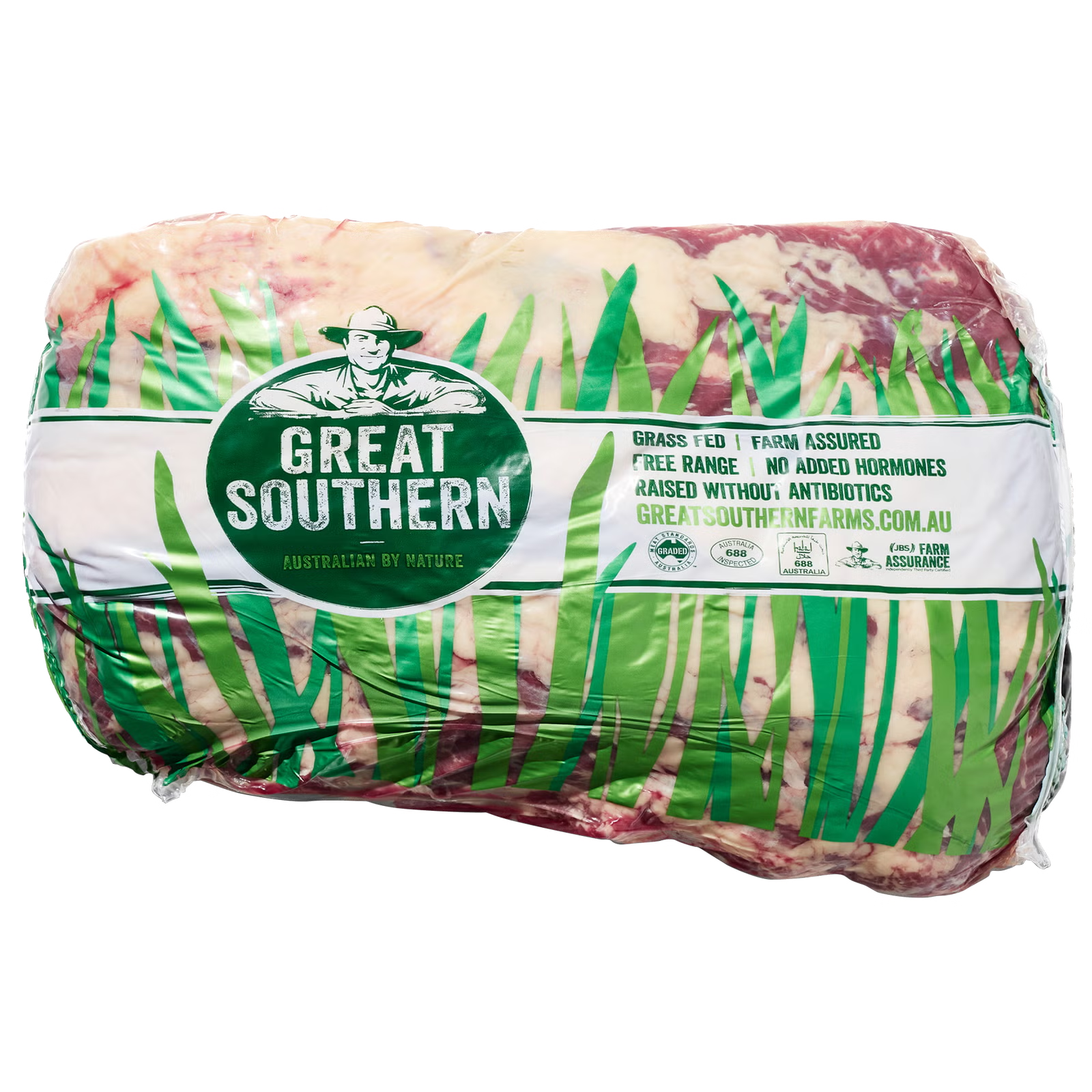
Portoro uses the JBS Farm Assurance Natural Grain programme and Certified Grain Fed specification, separate from Great Southern’s grass-fed programmes.
Useful source-scoped context without assigning an individual farm, current plant or unobserved treatment.
Programme certification claims are distinct from a current lot-specific certificate or measured audit outcome.
Grade · Meat Standards Australia / AUS-MEAT MSA graded; MB4+
MB4+ is Portoro’s Australian marbling specification of 4 or higher. MSA addresses eating quality; this is not a USDA Prime or Choice grade.
Useful source-scoped context without assigning an individual farm, current plant or unobserved treatment.
Marbling and eating-quality grading do not establish organic status, farm-welfare outcomes or nutritional superiority.
Processing
Cut and pack format · One ribeye primal, minimum 5.7 lb
One raw ribeye primal pack, minimum 5.7 lb. The listing sells a whole-cut portion rather than a stated number of individually portioned steaks.
Source-linked ordinary detail; nutrient declaration is not a clinical outcome or lot assay, and religious claim is not renewed third-party certification proof.
Advertised artwork and catalog declarations are not a received-lot inspection.
Physical carcass cleaning
Trimming, water and/or steam are used during Australian beef carcass cleaning.
This describes the carcass stage; it does not exclude later antimicrobial treatment.
Specific feeding, treatment or processing information takes precedence.
An unknown answer does not mean “none.” Check your package for current details.
KEEP EXPLORING