
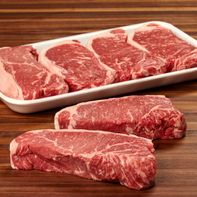
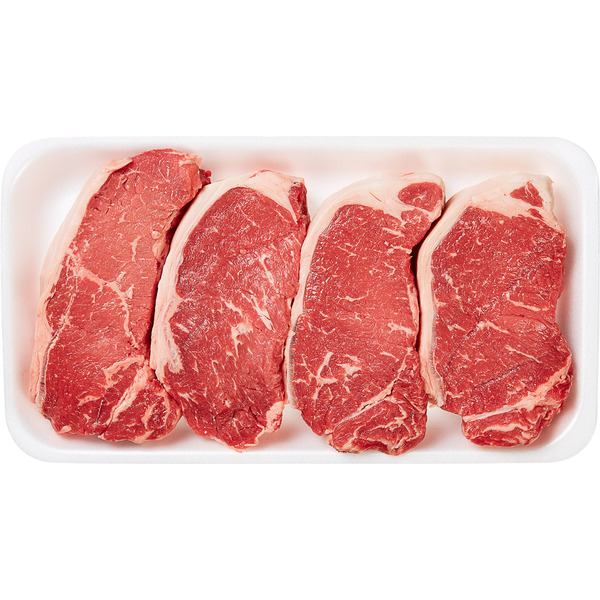
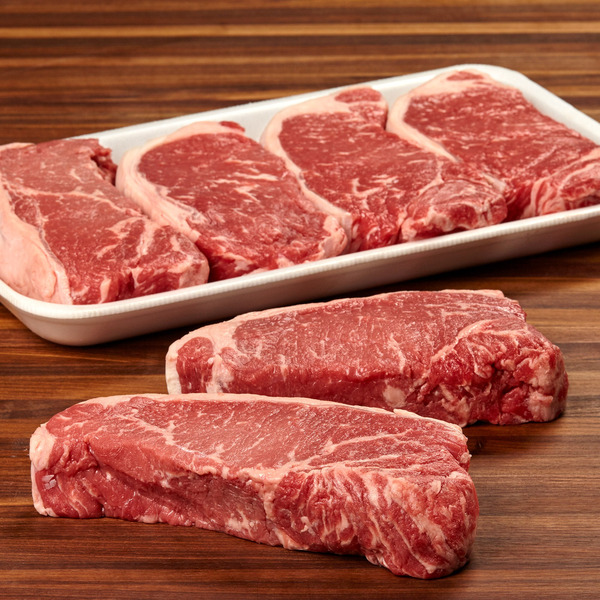
Product images · Packaging may change
Kirkland Signature USDA Choice Beef Loin New York Steak Boneless
USDA Choice NY steaks; likely blade tenderized, supported by matching packages through July 2026.
Mechanical tenderization
Likely blade tenderizedAntimicrobial wash
Antimicrobial washFood component
Likely beef onlyGrain-finished
Grain-finishedFeedlot-finished
Feedlot-finishedA CLOSER LOOK
The food facts.
Negatives
Mechanical tenderizationLikely blade tenderizedMediocre
Likely blade tenderized: matching 2013, November 2024, February 2025 and July 2026 packs declare it. Blades soften steak but can carry surface bacteria inside. Current packs may differ; no contamination is established.
More info
Mediocre
Likely blade tenderized: matching 2013, November 2024, February 2025 and July 2026 packs declare it. Blades soften steak but can carry surface bacteria inside. Current packs may differ; no contamination is established.
Blades break muscle fibers to improve tenderness. They can move surface bacteria into the steak, making the package’s cooking instructions important.
Blades and needles can carry surface bacteria into the centre of a cut. An intact steak avoids that extra route of contamination.
Current purchased package not received; dated package observations are not a national all-lot specification.
No measured production share or supplier protocol. Unlabelled current stock images do not confirm or refute treatment; a revised package may differ.
Antimicrobial washMediocre
An antimicrobial surface treatment is used during commercial beef processing.
More info
Mediocre
An antimicrobial surface treatment is used during commercial beef processing.
The wash reduces bacteria during processing. We prefer fewer chemical processing interventions.
Antimicrobial washes reduce bacteria during processing. We prefer a supply with fewer chemical processing interventions.
Specific feeding, treatment or processing information takes precedence.
Sources
- Cargill beef HACCP statement, January 2026 · Harvest-facility interventions; supports conventional-chain prior without assigning Cargill to this product
Grain-finishedMediocre
Fed grain during the finishing stage before slaughter.
More info
Mediocre
Fed grain during the finishing stage before slaughter.
Grain finishing differs from lifetime forage feeding. We favor meat raised on forage throughout life.
Grain finishing supplies energy-dense feed for weight gain and marbling before slaughter. We would choose grass and forage for cattle. In beef comparisons, forage feeding generally produces more omega-3 fat and a lower omega-6 to omega-3 ratio.
Actual supplier, ration and grain proportion are unresolved.
Specialty production or a newer package claim could change this inference.
Sources
- USDA cattle production and trade · Cattle feeding; U.S. beef trade
Feedlot-finishedBad
Finished in feedlot pens before slaughter.
More info
Bad
Finished in feedlot pens before slaughter.
Feedlot finishing limits the freedom to graze and range during the final raising stage.
Feedlot finishing concentrates animals in pens around supplied feed, limiting their freedom to graze and range. The placement is Bad whether the finishing ration contains grass, grain or both.
Specific feeding, treatment or processing information takes precedence.
Pasture-raised early in life
Pasture access during the early raising stage, before finishing.
Early pasture access is ordinary background information. It does not earn a lifelong-pasture positive.
Actual birth herd and pasture duration are not identified.
Dairy-derived cattle or a different supplier system could change this inference.
Sources
- USDA cattle production · Cow-calf and stocker production
Retailer antibiotic policy
Costco’s 2025 policy permits veterinary-supervised medically important antibiotics for disease prevention, control and treatment. Actual use in this beef is unconfirmed.
Selected exact-item observations and qualified continuity inference, with dated handling and retailer-policy context; no current supplier or animal origin is allocated.
Current purchased package not received; dated package observations are not a national all-lot specification.
Retailer welfare-audit requirements
Costco’s 2026 North American policy requires annual slaughter-plant audits; farm-audit frequency varies. Its risk-based system does not obtain audits for every facility. This is a requirement, not this beef’s audit result.
Selected exact-item observations and qualified continuity inference, with dated handling and retailer-policy context; no current supplier or animal origin is allocated.
Current purchased package not received; dated package observations are not a national all-lot specification.
Product information
Origin & producer
Related businesses
Brand · Kirkland Signature
Kirkland Signature
Dated country claim · Product of USA (2013 label)
A 2013 label says Product of USA. The origin of a current package is not confirmed.
Useful product context; no separate quality placement.
Sources
- Historical package · Product of USA; PACK DATE 03/29/13
Origin & producer notes · The retained Product of USA label has a March 29, 2013 pack date. Current origin is unresolved.
The retained Product of USA label has a March 29, 2013 pack date. Current origin is unresolved.
Certifications
Grade · USDA Choice
USDA Choice
Processing
Historical tenderization · Blade-tenderized label from 2013
A matching March 29, 2013 pack says blade tenderized. This historical observation alone does not establish treatment of a current pack.
Useful product context; no separate quality placement.
The surrounding article’s packaging-gas discussion does not establish gases used on this product.
Sources
- Historical item 33593 package · Package photograph: PACK DATE 03/29/13; item #33593
Pictured cooking instructions · 145°F plus a three-minute rest on July 2026 pack
The July 28, 2026 pack directs 145°F measured with a food thermometer, followed by a three-minute rest. These are that package’s instructions; follow your actual pack rather than the older 2013 cooking text.
Selected exact-item observations and qualified continuity inference, with dated handling and retailer-policy context; no current supplier or animal origin is allocated.
Current purchased package not received; dated package observations are not a national all-lot specification.
Pictured storage instructions · Keep refrigerated or frozen
The July 2026 package says Keep Refrigerated or Frozen. This storage instruction does not establish prior freezing, aging time or packaging gases.
Selected exact-item observations and qualified continuity inference, with dated handling and retailer-policy context; no current supplier or animal origin is allocated.
Current purchased package not received; dated package observations are not a national all-lot specification.
Processing notes · Blade tenderization appears on matching 2013, November 2024, February 2025 and July 28, 2026 labels. This supports a likely practice, not identical treatment of every current package.
Blade tenderization appears on matching 2013, November 2024, February 2025 and July 28, 2026 labels. This supports a likely practice, not identical treatment of every current package.
How it's raised
Pasture-raised early in life
Pasture access during the early raising stage, before finishing.
Early pasture access is ordinary background information. It does not earn a lifelong-pasture positive.
Actual birth herd and pasture duration are not identified.
Dairy-derived cattle or a different supplier system could change this inference.
Sources
- USDA cattle production · Cow-calf and stocker production
Retailer antibiotic policy · Veterinary antibiotics permitted under 2025 policy
Costco’s 2025 policy permits veterinary-supervised medically important antibiotics for disease prevention, control and treatment. Actual use in this beef is unconfirmed.
Selected exact-item observations and qualified continuity inference, with dated handling and retailer-policy context; no current supplier or animal origin is allocated.
Current purchased package not received; dated package observations are not a national all-lot specification.
Retailer welfare-audit requirements · Annual slaughter audits required under 2026 North American policy
Costco’s 2026 North American policy requires annual slaughter-plant audits; farm-audit frequency varies. Its risk-based system does not obtain audits for every facility. This is a requirement, not this beef’s audit result.
Selected exact-item observations and qualified continuity inference, with dated handling and retailer-policy context; no current supplier or animal origin is allocated.
Current purchased package not received; dated package observations are not a national all-lot specification.
Ingredients
Food component · Likely beef only
Likely beef only, based on the plain raw steak identity and matching photographs. This is not a full ingredient declaration; added solutions, retained water and processing aids remain unconfirmed.
Selected exact-item observations and qualified continuity inference, with dated handling and retailer-policy context; no current supplier or animal origin is allocated.
Current purchased package not received; dated package observations are not a national all-lot specification.
An unknown answer does not mean “none.” Check your package for current details.
KEEP EXPLORING
Also in the meat aisle
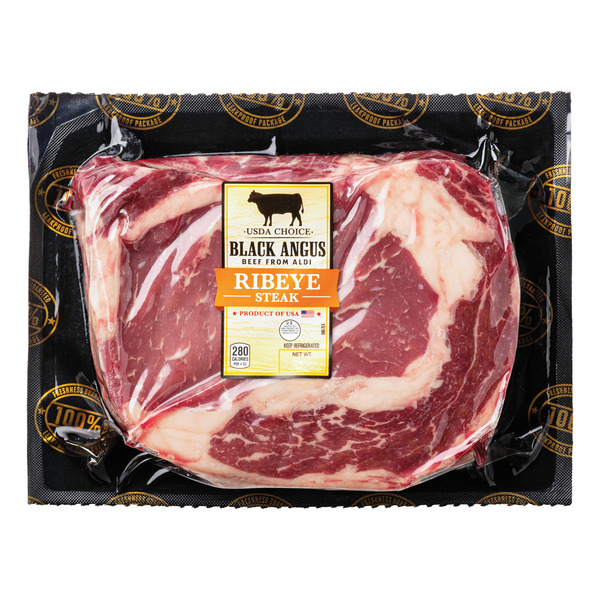
USDA Choice Black Angus Ribeye Steak
- Likely grain finished
- Likely grain finished
- Origin
- United States
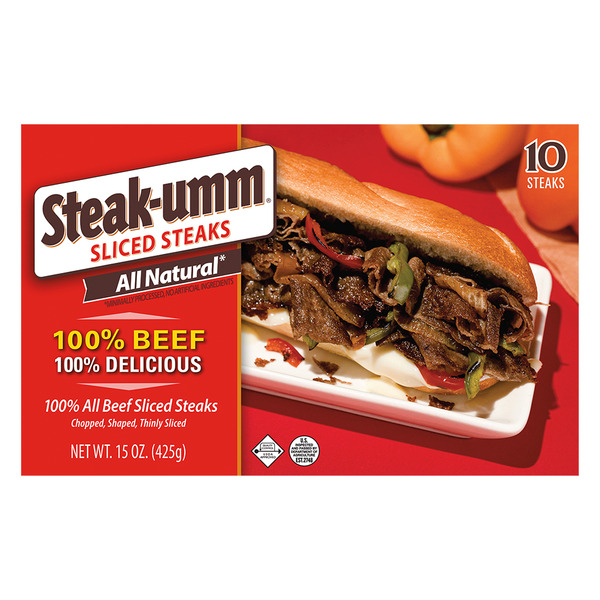
Steak-umm
Steak-umm 100% Beef Sliced Steaks, 10 Steaks, 15 oz
- Feed
- Not specified
- Origin
- Not specified
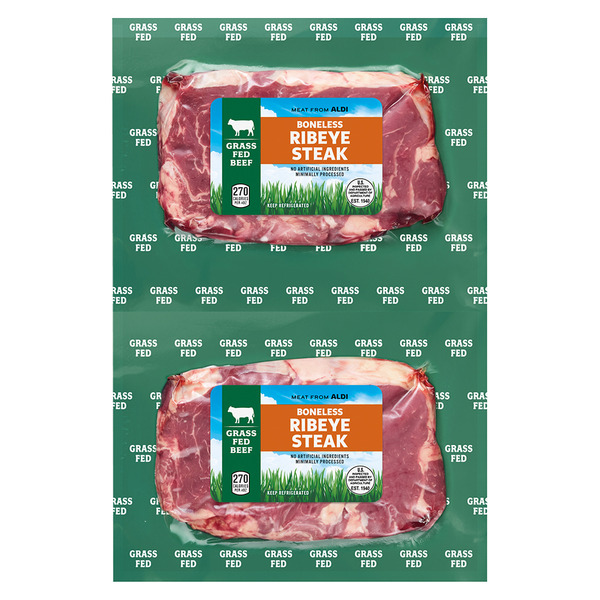
Grass-Fed Boneless Ribeye Steak
- 100% grass-fed
- 100% grass-fed
- Origin
- United States