
Product images · Packaging may change
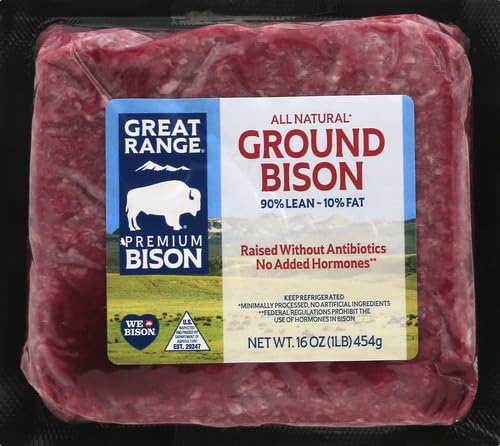
Great Range Ground Bison, 16 oz
U.S. and Canadian bison. Pasture and hay, then grain finishing.
Peracetic acid (PAA)
Henderson meat and trim wash (2024/2026)Feed
Grain before harvestGMO feed
Permitted by policyOrigin
United States, CanadaA CLOSER LOOK
The food facts.
Negatives
Peracetic acid (PAA)Henderson meat and trim wash (2024/2026)Mediocre
FeedGrain before harvestMediocre
Pasture forage and hay, with grain added before harvest. Grain types vary by ranch; the exact ration and finishing duration for this pack are unconfirmed.
More info
Mediocre
Pasture forage and hay, with grain added before harvest. Grain types vary by ranch; the exact ration and finishing duration for this pack are unconfirmed.
Grain finishing can shift bison meat toward a higher omega-6-to-omega-3 fat ratio than grass finishing.
Grain finishing supplies energy-dense feed for weight gain and marbling before slaughter. We would choose grass and forage for cattle. In beef comparisons, forage feeding generally produces more omega-3 fat and a lower omega-6 to omega-3 ratio.
The company describes consistency and flavor as reasons for grain feeding.
The study measured bison striploin composition, not this product or human health outcomes. Feed and growing conditions affect the result.
Sources
- Great Range feeding FAQ · What are your Bison fed? / grain-fed or grass-fed?
- Bison finishing and fatty acids — 2023 study · Table 5 and discussion: fatty acid profiles; pasture vs 146-day concentrate finishing
GMO feedPermitted by policyMediocre
GMO grain is allowed, though some ranchers use non-GMO grain.
More info
Mediocre
GMO grain is allowed, though some ranchers use non-GMO grain.
A feed-sourcing concern: the program allows genetically modified crops.
GMO feed is permitted, so the ration can include genetically engineered crops. We would choose non-GMO feed.
Sources
- GMO grain FAQ · Are your Bison fed GMO grains?
Product information
Origin & producer
Related businesses
Country of origin · United States, Canada
United States, Canada
Slaughtered in · Brush, Colorado, United States (dated source)
Brush supplies Henderson under the December 2024 guarantee and January 2026 audit; emergency sourcing may differ. The pictured pack identifies Henderson EST. 20247 for cutting and grinding, not an individual slaughter lot.
Expose existing supported answers and source once, without new certification, animal origin, chemical outcome or private original disclosure.
No actual received lot, complete current rear panel or independently verified programme execution.
Processed in · Henderson, Colorado, United States (dated source)
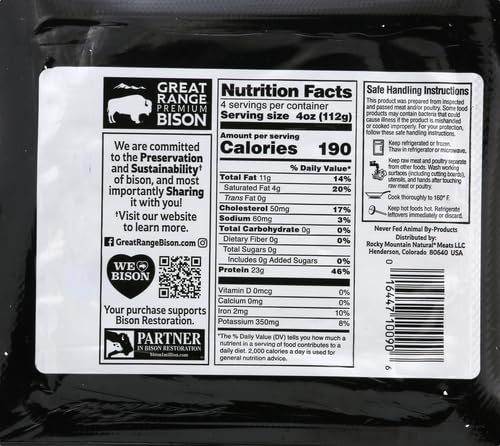
The retained one-pound package identifies RMNM, Henderson, Colorado (EST. 20247), for processing and packing. It does not allocate a ranch or raising country to this package; current lots may differ. Undated package image; current lots may differ.
Concrete product practice or scoped provenance, without a measured safety, nutrition or environmental outcome.
Advertised artwork and programme statements do not identify every current purchased lot.
Brand · Great Range Bison
Great Range Bison
Brand owner · Rocky Mountain Natural Meats LLC (dated source)
Henderson is identified on the package; Brush is the slaughter supplier in 2024–2026 facility records.
Processor · Rocky Mountain Natural Meats / Brush Meat Processors — Brush (dated source)
Henderson is identified on the package; Brush is the slaughter supplier in 2024–2026 facility records.
Brand ranch partners · Beldon, Black Kettle, Land Link; Slim Buttes (2024)
Published partners include Beldon (Saskatchewan), Black Kettle (Kansas) and Land Link (Alberta). Slim Buttes reported deliveries in 2024. These are network relationships, not the ranch supplying this package.
Great Range publishes supplier profiles for Beldon Bison Ranch in Saskatchewan, Black Kettle Buffalo in Kansas and Land Link Investments in Alberta. These are network examples, not this package’s confirmed ranch.
This describes the published program; the particular package is not traced to an individual farm or lot.
Feed
Feed exclusions · No animal by-products
No animal by-products
How it's raised
Pasture access · Pasture raised
Pasture-raised before finishing under Great Range’s programme. Outdoor access during grain finishing is not established.
Pasture access gives the bison opportunities to graze and move outdoors.
No package-specific stocking density or finishing-enclosure record is available.
The animals have pasture access, but the program does not confirm year-round access through finishing for this meat.
Sources
- Great Range husbandry FAQ · How are your Bison raised?
Minimal handling; no castration, dehorning or branding
Minimal handling, with no castration, dehorning or branding.
Stated husbandry methods and harvest age provide useful programme context, not independently measured welfare or nutrition outcomes.
No independent ranch audit or individual animal husbandry record was inspected.
Breeding-herd lifetime pasture language does not establish pasture finishing for meat animals.
Natural breeding; harvest at 24–30 months
Natural breeding, without artificial insemination or embryo transfer. Great Range gives a typical harvest age of 24–30 months; the age and breeding records for this package’s animals are undisclosed.
Stated husbandry methods and harvest age provide useful programme context, not independently measured welfare or nutrition outcomes.
No independent ranch audit or individual animal husbandry record was inspected.
Breeding-herd lifetime pasture language does not establish pasture finishing for meat animals.
Antibiotics & hormones
No antibiotics
Excellent
Raised without antibiotics, according to the pictured package.
Routine antibiotic use can select for resistant bacteria. A no-antibiotics supply commitment keeps treated animals out of that programme; sick animals still need care.
The pictured claim describes the producer’s raising standard; it is not an individual animal treatment record.
Raised without antibiotics. Limiting routine antibiotic use helps reduce selection for antibiotic-resistant bacteria. Sick animals can still receive care and be kept out of this supply.
A pictured package does not establish the treatment history or source of a purchased lot.
Sources
No added hormones
Excellent
No added hormones, according to the pictured package. The package says federal regulations prohibit hormone use in bison.
Added growth hormones accelerate weight gain. We would choose meat raised without that intervention.
The package footnote describes a bison-wide regulatory baseline; it does not establish an individual animal treatment history.
A no-added-hormones commitment excludes hormone treatments used to accelerate weight gain.
A pictured package does not establish the treatment history or source of a purchased lot.
Sources
Processing
Freezing history · Never frozen
Never frozen under Great Range’s fresh-bison programme. This is the manufacturer’s supply-chain claim; frozen distributor formats and an individual package’s temperature record are separate.
Concrete product practice or scoped provenance, without a measured safety, nutrition or environmental outcome.
Advertised artwork and programme statements do not identify every current purchased lot.
No added solution
Excellent
No added solution
Added solution introduces water and other ingredients into meat, changing what you are buying by weight.
Added solution introduces water and other ingredients into meat, changing what you are buying by weight.
Carcass treatment · Rinse & Chill
Post-slaughter vascular rinse, separate from finished-meat solution injection. A published bison formula names glucose, maltose and polyphosphates in water. RMNM’s 2025 programme account does not establish this pack’s actual recipe or retained amounts.
Vascular rinsing occurs upstream on the carcass and is distinct from injecting an added solution into finished retail meat. Provider formulation and benefits are not product-specific measurements.
Current RMNM commercial formula, execution and retained amounts are unverified.
Provider generic water/sugar/electrolyte description is not an exact current recipe for this package.
Sources
Processing treatments · 5 named treatments
Mediocre
5 named treatments
The full treatment list is not established.
BromineBrush slaughter wash (2024)Unrated
Bromine wash at Brush slaughter, documented in RMNM’s December 2024 programme. It is used to reduce microbial contamination; current package execution and concentration are unconfirmed.
This named treatment has no reviewed positive or negative placement in the pilot.
Concentrations, current lot execution and the complete treatment list are not established.
Hot waterBrush hot-water wash (2024)Unrated
Hot-water wash at Brush slaughter, identified as a critical food-safety control in RMNM’s December 2024 programme. The record does not establish this package’s actual time or temperature.
This named treatment has no reviewed positive or negative placement in the pilot.
Concentrations, current lot execution and the complete treatment list are not established.
Lactic acidBrush and Henderson washes (2024)Unrated
Lactic-acid washes at Brush slaughter and on incoming carcasses at Henderson, documented in RMNM’s December 2024 programme. Used to reduce microbial contamination; current concentration and package execution are unconfirmed.
This named treatment has no reviewed positive or negative placement in the pilot.
Concentrations, current lot execution and the complete treatment list are not established.
Peracetic acid (PAA)Henderson meat and trim wash (2024/2026)Mediocre
Mediocre
Peracetic-acid wash for meat cuts and trimmings at Henderson, documented in the December 2024 guarantee and January 2026 audit. Used to reduce microbial contamination; the exact formulation and current package execution are unconfirmed.
Stabilizer residues: Some PAA blends contain HEDP, which can remain on meat. Worker exposure: PAA mist and vapor can irritate eyes, skin and airways. Bacterial tolerance: Repeated sublethal exposure increased PAA tolerance in some Listeria strains in lab tests. Hygiene concerns: In the poultry-wash debate, consumer group BEUC warned that chemical washes could replace efforts to prevent contamination.
PAA washes kill bacteria during processing. We would choose meat without this extra chemical treatment. Some formulations include HEDP, a stabilizer that can remain on meat. PAA mist can also irritate workers’ eyes and airways.
PAA use is established for the stated program or facility scope; these general concern sources do not identify this product’s wash formula or measure its residues.
HEDP occurs in some formulations, not all. The cited EFSA poultry assessment found no toxicity concern at the exposures assessed and did not expect measurable lipid peroxidation.
Worker irritation concerns chemical contact and inhalation. No injury or unsafe exposure at this product’s processor is established.
The bacterial-tolerance study used repeated sublethal exposure in laboratory broth, not a commercial carcass wash or this product. It does not establish antibiotic-resistant infection in shoppers.
BEUC’s 2014 position concerns poultry-decontamination policy. Its warning is not evidence of poor hygiene at this product’s processor.
Sources
- PAA formulations — USDA technical review · Composition and stabilizers; general chemistry, not this product’s wash formula
- PAA and HEDP assessment — EFSA, 2014 · Summary and toxicological safety; poultry exposure scenarios
- Worker exposure — NIOSH · March 2017 background: eye, respiratory-tract and skin irritation
- PAA adaptation in Listeria — 2025 laboratory study · Sections 2.4, 3.3 and Table 3; repeated sublethal exposure, not carcass treatment
- Hygiene concerns — BEUC’s 2014 poultry position · Pages 2, 4 and 11: attributed concern about reliance on chemical washes
Lauric arginateHenderson meat wash (2024/2026)Unrated
Lauric-arginate wash at Henderson, documented in the December 2024 guarantee and January 2026 audit. Used to reduce microbial contamination; current concentration and package execution are unconfirmed.
This named treatment has no reviewed positive or negative placement in the pilot.
Concentrations, current lot execution and the complete treatment list are not established.
Ingredients
Ingredients · Ground bison
Excellent
Ground bison on the Kroger ingredient declaration; the matched one-pound package identifies 90% lean and 10% fat. Ingredient wording does not exclude upstream processing aids.
Plain meat best fits our ingredient preference. A simple ingredient list cannot rule out processing aids used earlier.
Ingredient declaration and upstream processing are separate.
Ingredients describe what goes into the food. Processing treatments are covered separately.
No actual current lot treatment record.
Certifications
Certification scope · Certified Humane coverage unconfirmed
A 2026 certifier-directory entry lists Great Range ground bison but requires the product’s logo. The matched one-pound image shows no seal; coverage of this pack remains unconfirmed.
Expose existing supported answers and source once, without new certification, animal origin, chemical outcome or private original disclosure.
No actual received lot, complete current rear panel or independently verified programme execution.
An unknown answer does not mean “none.” Check your package for current details.
KEEP EXPLORING
Also in the meat aisle
Great Range Bison
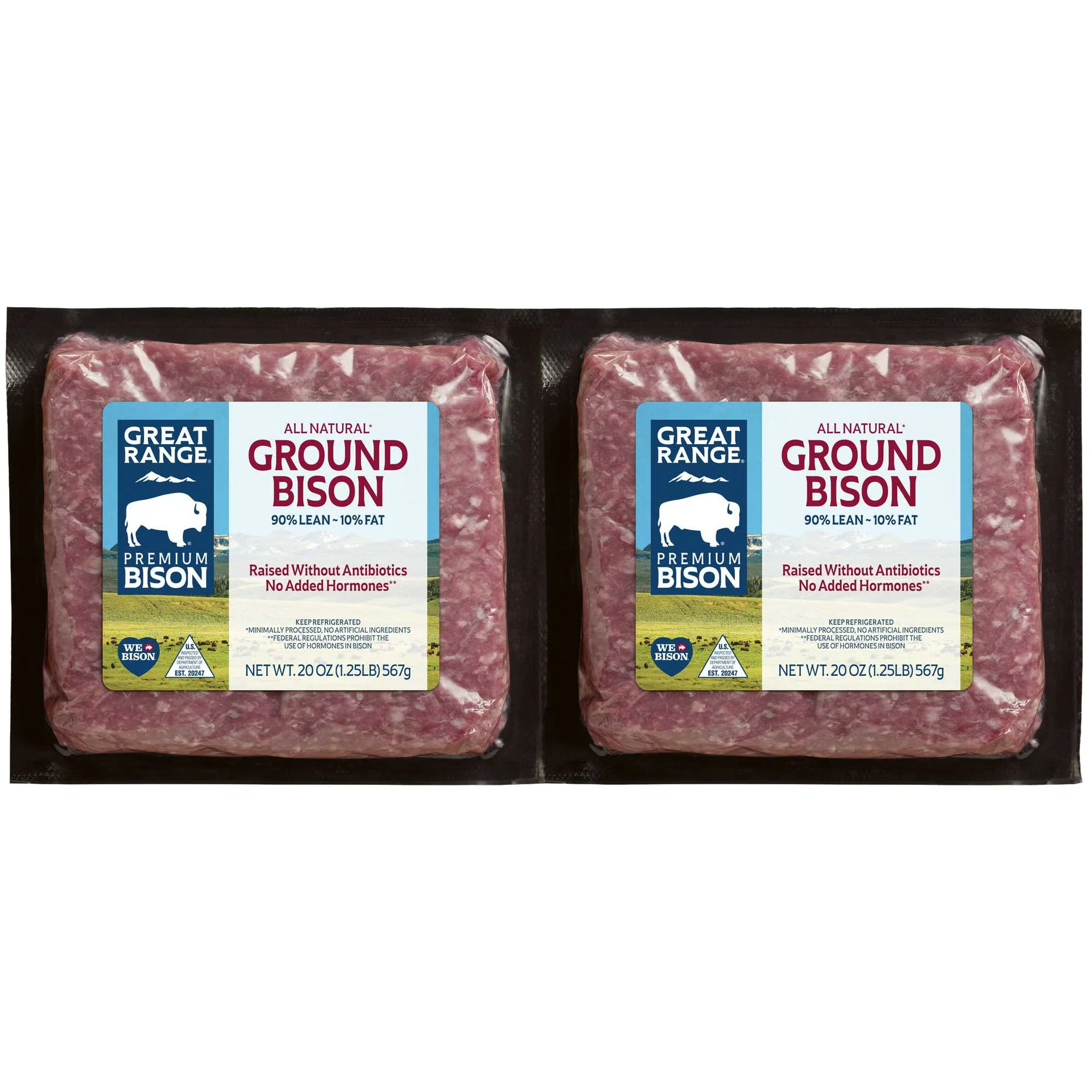
Great Range Ground Bison 90% Lean, 1.25 lbs, 2-count
- Grain-finished
- Grain-finished
- Origin
- United States, Canada
Northfork
Northfork Ground Bison
- Feed
- Grain for 100–150 days
- Origin
- Canada
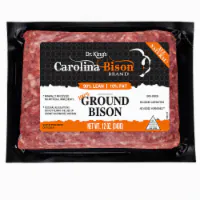
Dr. King’s Carolina Bison
Dr. King's Carolina Bison Ground Bison 90/10, 12 oz
- Feed
- Grass / forage
- Origin
- Not specified