
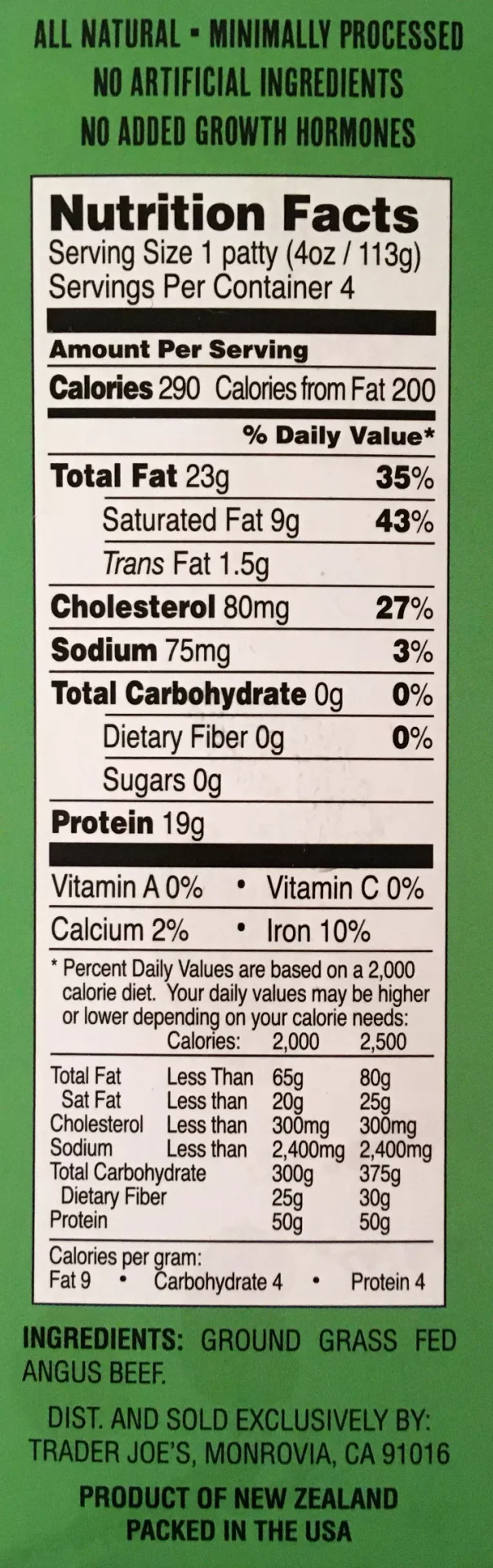
Product images · Packaging may change
Uncooked Grass Fed Angus Beef Burgers 80% Lean / 20% Fat
Frozen 100% grass-fed Angus beef burgers; the July 2020 package identifies New Zealand beef and U.S. packing.
A CLOSER LOOK
The food facts.
Positives
Feed100% grass-fedGood
Grass and forage after weaning through finishing, with pasture access during the growing season. Vitamin and mineral supplements are allowed.
More info
Good
Grass and forage after weaning through finishing, with pasture access during the growing season. Vitamin and mineral supplements are allowed.
The lifetime-forage preference applies to the claim’s stated production programme. The missing literal 100% wording does not make an unqualified U.S. grass-fed claim a different feeding standard.
A lifetime forage diet excludes grain, including during finishing. Grass-fed beef generally has more omega-3 fat and a lower omega-6 to omega-3 ratio than grain-fed beef.
The product’s selected claim/source dates are retained; no new purchased label or farm audit was obtained.
Routine minerals/vitamins and documented nonroutine deviations for inadvertent exposure or animal wellbeing are permitted by the guidance.
Actual ranch, ration execution and a label approval dossier are not independently established.
Sources
- July2020 matched grass-fed Angus burger label
- FSIS animal-raising and diet-claim guidance · August 2024, printed p.13: grass-fed synonymous terms; growing-season pasture; supplementation exceptions
- FSIS guidance — publicly accessible agency-document copy · Printed pp.13–14: diet-claim meaning and substantiation
Non-GMO claim scope
It cannot confirm that its meat comes from animals fed only non-GMO feed.
Useful programme meaning without inventing a lot observation, medical outcome or quality rating.
This is the retailer’s claim boundary, not evidence that this animal ate GMO feed.
Organic and explicit non-GMO-feed programmes are excluded from this selection.
Sources
- Trader Joe’s product FAQ · Retained September 19, 2026 FAQ: animal feed and non-GMO ingredient programme
Product information
Origin & producer
Related businesses
Country of origin · New Zealand (dated source)
Where the animals or meat come from. SKU-matched 2019–2021 package labels; origin and ingredients from July 2020.
Packed in · United States (dated source)
SKU-matched 2019–2021 package labels; origin and ingredients from July 2020.
Brand · Trader Joe’s
Trader Joe’s
U.S. processing · Nordic Foods, Kansas (2019/2021 photos)
Matched package photos uploaded in 2019 and 2021 bear EST. 5520: Nordic Foods, Kansas City, Kansas. These are dated U.S. processing observations; photo-upload dates are not production dates.
Actual practice or dated processing context; not a farm audit, measured clinical outcome or current lot trace.
Origin & producer notes · New Zealand origin and U.S. packing appear on the July 2020 package.
New Zealand origin and U.S. packing appear on the July 2020 package.
Feed
Non-GMO claim scope · Non-GMO ingredients do not guarantee non-GMO feed
It cannot confirm that its meat comes from animals fed only non-GMO feed.
Useful programme meaning without inventing a lot observation, medical outcome or quality rating.
This is the retailer’s claim boundary, not evidence that this animal ate GMO feed.
Organic and explicit non-GMO-feed programmes are excluded from this selection.
Sources
- Trader Joe’s product FAQ · Retained September 19, 2026 FAQ: animal feed and non-GMO ingredient programme
Antibiotics & hormones
No added hormones (dated source)
Excellent
No added growth hormones. SKU-matched 2019–2021 package labels; origin and ingredients from July 2020.
Added growth hormones accelerate weight gain. We would choose meat raised without that intervention.
A no-added-hormones commitment excludes hormone treatments used to accelerate weight gain.
Antibiotics & hormones notes · No added growth hormones is a July 2020 package claim.
No added growth hormones is a July 2020 package claim.
Processing
Freezing history · Sold frozen (dated source)
SKU-matched 2019–2021 package labels; origin and ingredients from July 2020.
Historical cooking instructions · Historical 150°F option below federal guidance
The package photographed in a July 2020 review offers 150°F for medium burgers. FoodSafety.gov recommends 160°F for ground meat, checked with a thermometer. The historical label does not establish current package instructions.
Preparation guidance discrepancy, without a contamination finding, illness attribution or product-quality rating.
No current exact package instructions or validated alternative lethality procedure recovered.
Sources
- Historical exact burger cooking panel
- FoodSafety.gov minimum internal temperatures · Ground meat160°F; thermometer guidance. Current page read October18,2026; page review date November21,2024.
Supplier food-safety audits · Annual food-safety audits required
Trader Joe’s requires annual GFSI-benchmarked food-safety audits for sites that process, pack, store or distribute its products. This supplier standard does not certify farm animal care or disclose this package’s audit results.
Annual benchmarked food-safety auditing is a stated supplier-control requirement. It does not establish farm welfare certification, independent product quality, current audit execution or a lot-level safety result.
Individual site audit bodies, findings, corrective actions and this package’s allocation were not recovered in this selection.
Sources
- Trader Joe’s Potential Vendor Requirements · Annual GFSI-benchmarked audits: processing, packing, storage and distribution sites. September19 body; October18 canonical rendered review.
Ingredients
Ingredients · Ground grass-fed Angus beef (dated source)
What is added to the meat. SKU-matched 2019–2021 package labels; origin and ingredients from July 2020.
How it's raised
Growing-season pasture access
Continuous pasture access during the growing season under the advertised grass-fed programme. This does not establish year-round outdoor access, grazing days or independently measured farm conditions.
FSIS cattle diet-claim guidance at physical/printed13 gives unqualified grass-fed and100%grass-fed claims the same postweaning forage meaning and growing-season pasture access. The guidance explains intended substantiation rather than independently proving execution or creating standalone binding law. Mixed/time-limited claims differ and are excluded.
Existing product source/version dates remain unchanged; no new physical label, current farm audit or exact programme enrolment recovered.
Year-round access, stocking density, rotation, painful procedures and actual grazing duration remain unconfirmed.
Routine vitamins/minerals and documented incidental/nonroutine supplementation are distinct from ordinary grain finishing.
Sources
- Exact selected grass-fed product claim, at retained source dates
- FSIS August2024 animal-raising and diet-claim guidance · Printed/physical13: cattle GrassFed and partiallygrassfed claims, growing-season pasture and supplementation
- Public agency-document copy: FSIS August2024 guidance · Page 13
An unknown answer does not mean “none.” Check your package for current details.
KEEP EXPLORING
Also in the meat aisle
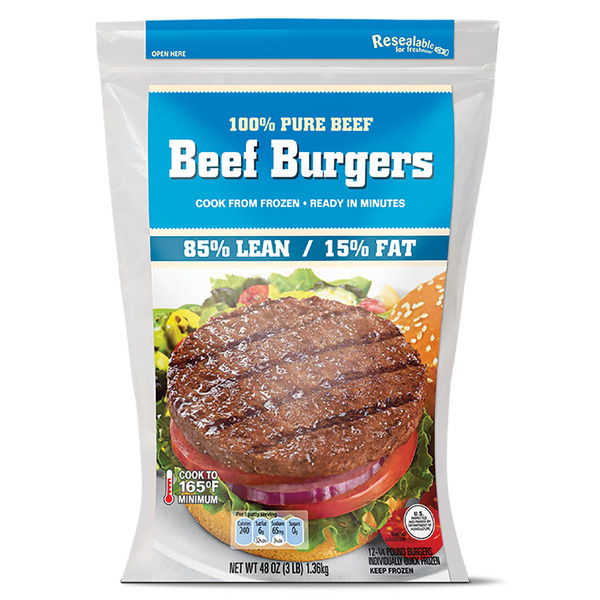
85% Lean / 15% Fat Beef Patties
- Likely some grain-finished beef
- Likely some grain-finished beef
- Origin
- United States
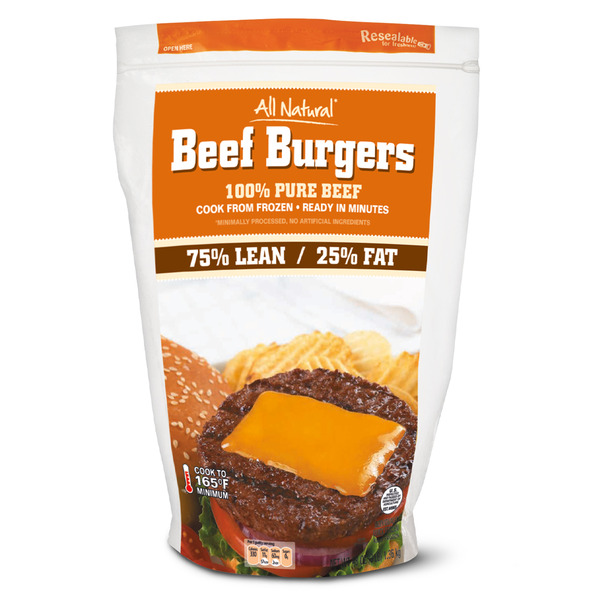
All Naturals
All Naturals 75% Lean / 25% Fat Beef Patties
- Likely some grain-finished beef
- Likely some grain-finished beef
- Origin
- United States
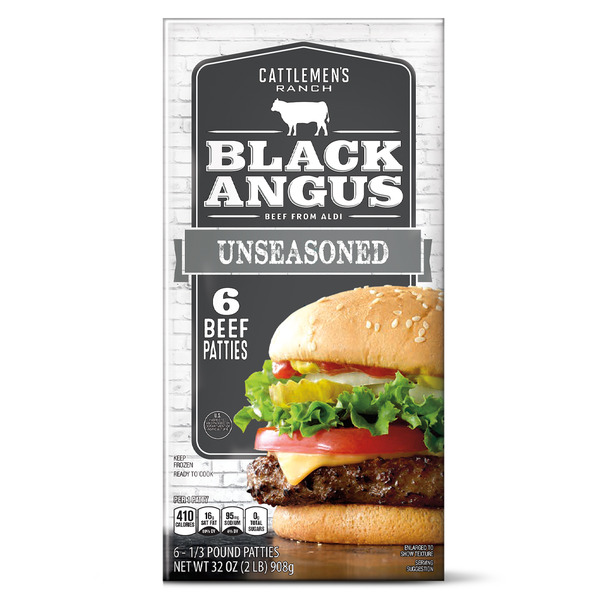
Cattlemen’s Ranch
Cattlemen's Ranch Unseasoned Black Angus Beef Patties, 6 Pack
- Likely some grain-finished beef
- Likely some grain-finished beef
- Origin
- United States