
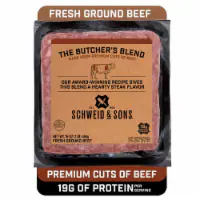
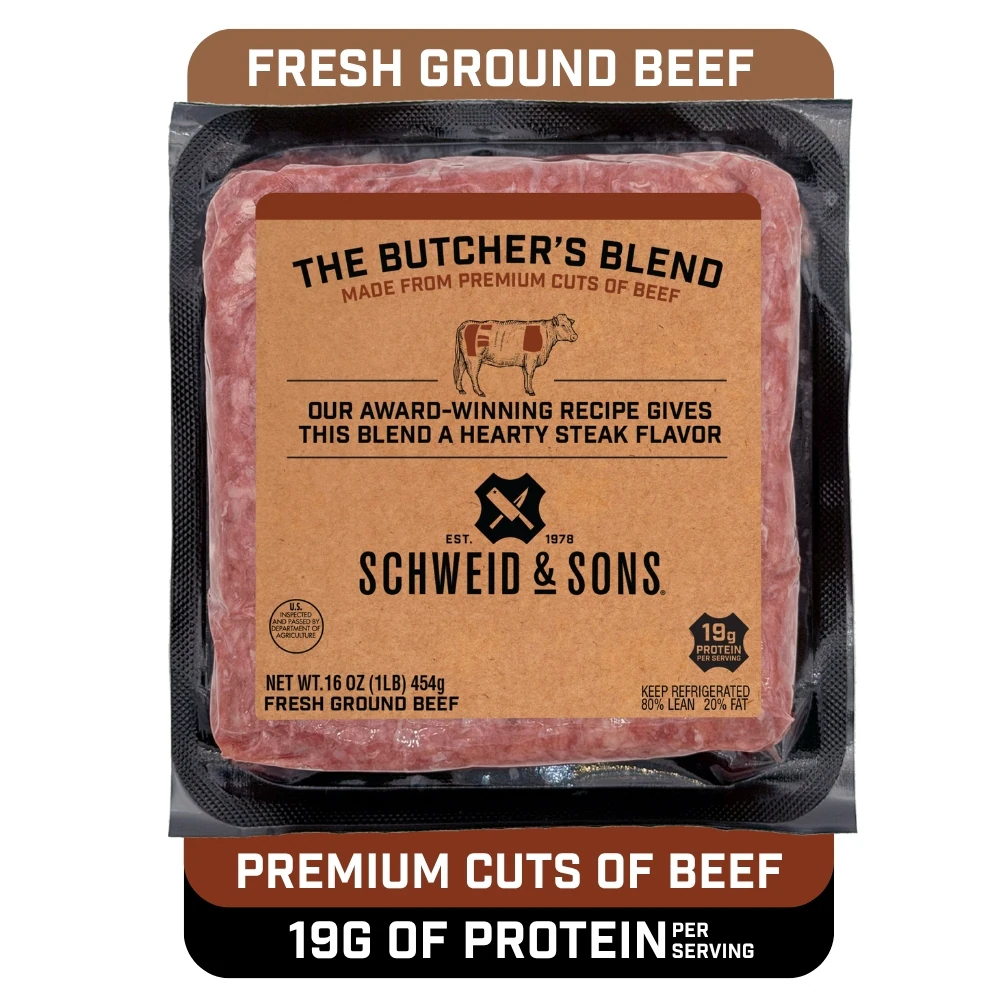
Product images · Packaging may change
Schweid & Sons The Butcher's Blend Ground Beef 1 lb Brick
Chuck, round and sirloin. Likely includes grain-finished beef.
Origin
United States, Australia, New ZealandLikely some grain-finished beef
Likely some grain-finished beefA CLOSER LOOK
The food facts.
Negatives
Likely some grain-finished beefMediocre
Likely includes grain-finished beef. The identified conventional U.S. sourcing and usual ground-beef supply pattern support this inference; it does not establish the diet of every animal in the blend.
More info
Mediocre
Likely includes grain-finished beef. The identified conventional U.S. sourcing and usual ground-beef supply pattern support this inference; it does not establish the diet of every animal in the blend.
The matched conventional blend and U.S. sourcing support likely grain-finished input under USDA’s production model. Historical 2011 grain preference is corroborating context, not a current specification. Imported or cow-derived inputs need not all share that finish; no ingredient ratio, medicine use or health hazard inferred.
Grain finishing supplies energy-dense feed for weight gain and marbling before slaughter. We would choose grass and forage for cattle. In beef comparisons, forage feeding generally produces more omega-3 fat and a lower omega-6 to omega-3 ratio.
Actual cattle mix, ration and proportion of grain-finished input are unresolved.
Butcher’s Blend includes a small Australian/New Zealand share; dairy/cull or specialty inputs can differ.
Sources
- USDA cattle production and trade · Cattle feeding; U.S. beef trade
- Schweid current U.S. and Butcher’s Blend sourcing · Imported beef and sourcing answers
Product information
Origin & producer
Related businesses
Country of origin · United States, Australia, New Zealand
United States, Australia, New Zealand
Brand · Schweid & Sons
Schweid & Sons
Producer · Schweid & Sons
Schweid & Sons
Blend sourcing · U.S. beef with a small share from Australia and New Zealand
The Butcher’s Blend includes a small percentage of beef from Australia and New Zealand alongside U.S. sourcing. Its other products use U.S.-sourced beef.
Schweid & Sons says The Butcher’s Blend includes a small percentage of beef from Australia and New Zealand alongside U.S. sourcing. Its other products use U.S.-sourced beef.
Sourcing statement does not give percentages, farms or birth/slaughter countries.
Sources
Origin & producer notes · The Butcher’s Blend uses U.S. beef with a small percentage from Australia and New Zealand.
The Butcher’s Blend uses U.S. beef with a small percentage from Australia and New Zealand.
Processing
No added solution
Excellent
No added solution
Added solution introduces water and other ingredients into meat, changing what you are buying by weight.
Added solution introduces water and other ingredients into meat, changing what you are buying by weight.
Pre-grind spray disclosure — 2021 · Pre-grind antimicrobial spray described (2021)
Antimicrobial spraying of incoming beef before grinding was described in Schweid’s 2021 processing interview. The spray agent and use on this package are unconfirmed.
The described purpose is reducing contamination spread during grinding. A spray on meat is distinct from equipment sanitation. The source does not identify the agent, dose, current retail application or a measured residue/safety outcome.
No named chemical, current formulation or package treatment is assigned.
Supplier testing and test-and-hold
Incoming beef requires supplier E. coli O157:H7 test documentation. Production sampling, outside-laboratory testing and test-and-hold are company controls, not this package’s results.
Concrete practice or scoped network/history; no measured nutritional advantage, residue or current food-contamination finding inferred.
Programme relationships, dated events and artwork do not establish a current retail lot or every source animal.
Sources
Ground-beef storage guidance · USDA: use or freeze within 1–2 days of purchase
Schweid’s article allows up to a week after sell-by. USDA advises using or freezing ground meat within 1–2 days of purchase. Unopened vacuum packs and their use-by dates are a separate case.
Sell-by is a store inventory date. The manufacturer’s longer sell-by advice differs from USDA’s purchase-based consumer guidance; the separate unopened-vacuum/use-by discussion is not a universal opened-storage clock.
Schweid separately gives 1–2 days for opened or non-vacuum-packed raw beef and permits following the use-by date for unopened vacuum packs kept below 40°F.
A related slider sheet’s 21 days from manufacture does not establish storage after opening, purchase or thawing, nor apply to every UPC.
No actual mishandling, spoilage, illness or failure of an individual product is established.
Sources
- Schweid & Sons — How to Tell If Ground Beef Is Bad · Fridge storage; seven days; sell-by versus use-by sections
- USDA FSIS — How long is meat or poultry safe after sell-by? · Sell-by is inventory dating; ground meat use/freeze within1–2days of purchase
Ingredients
Ingredients · Beef
Excellent
Beef
Plain meat best fits our ingredient preference. A simple ingredient list cannot rule out processing aids used earlier.
Ingredients describe what goes into the food. Processing treatments are covered separately.
Chuck, round and sirloin
Chuck, round and sirloin beef blend. Cut proportions are not specified.
Concrete practice or scoped network/history; no measured nutritional advantage, residue or current food-contamination finding inferred.
Programme relationships, dated events and artwork do not establish a current retail lot or every source animal.
Sources
Advertised nutrition · 19 g protein per 4 oz
Per 4 oz (113 g): 290 calories, 19 g protein, 23 g fat including 9 g saturated fat, 80 mg cholesterol and 75 mg sodium.
Source-declared serving nutrition; no quality rating or clinical outcome inferred.
Manufacturer nutrition graphic; its upload folder does not date the label.
Feed
Feed notes · Likely includes grain-finished beef; individual animal diets can differ.
Likely includes grain-finished beef; individual animal diets can differ.
How it's raised
Likely some pasture-raised beef
Likely includes beef from cattle that grazed early in life. This follows the usual U.S. cow-calf pattern for the identified conventional sourcing; it does not establish pasture finishing or every source animal’s history.
Likely early grazing is a supported pasture-access positive and can coexist with grain finishing. No duration, lifetime housing, individual welfare audit or diet of every blend animal is established.
Individual herd type, pasture duration and final housing are not identified.
Dairy-derived, imported or specialty inputs may have different histories.
Sources
- USDA cattle production · Cow-calf and stocker production
- Schweid current sourcing and programme exceptions
An unknown answer does not mean “none.” Check your package for current details.
KEEP EXPLORING
Also in the meat aisle
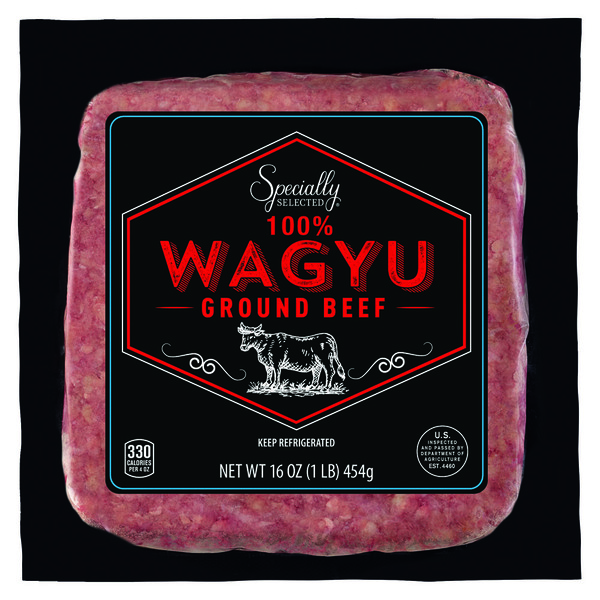
Specially Selected
Specially Selected 75% Lean/25% Fat Wagyu Ground Beef
- Likely grain finishing
- Likely grain-finished
- Origin
- Not specified
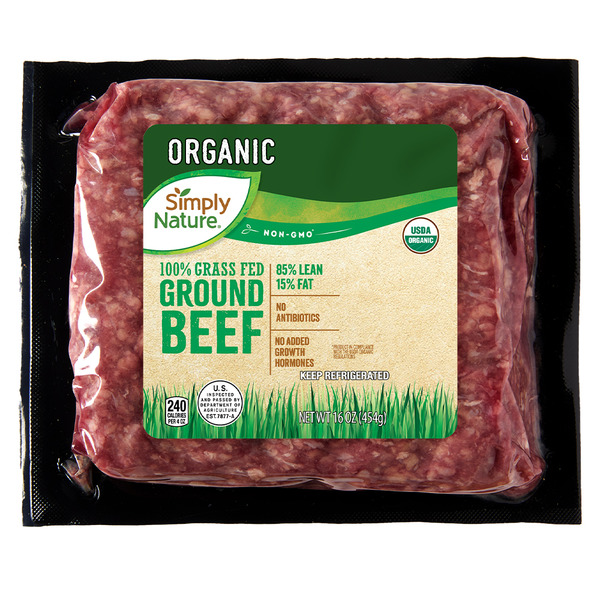
Simply Nature
Simply Nature Organic Grass Fed 85% Lean Ground Beef
- Feed
- 100% grass-fed
- Origin
- Australia, Uruguay, United States
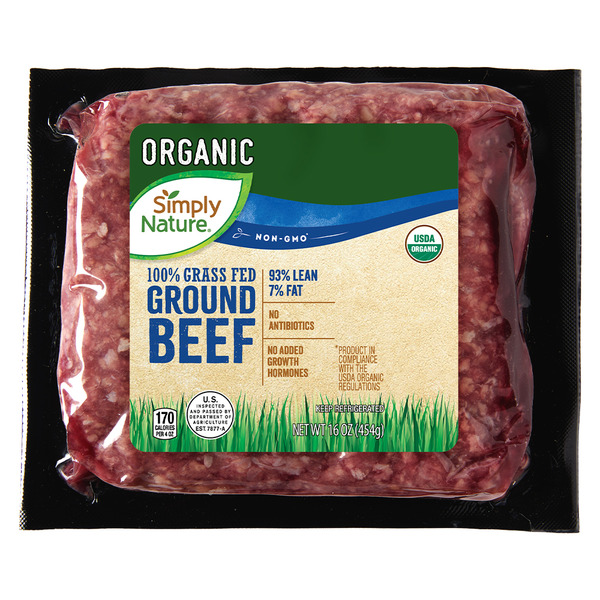
Simply Nature
Simply Nature Organic 100% Grass-Fed 93% Lean Ground Beef
- Feed and finishing
- 100% grass-fed organic non-GMO
- Origin
- Australia, Uruguay, United States