
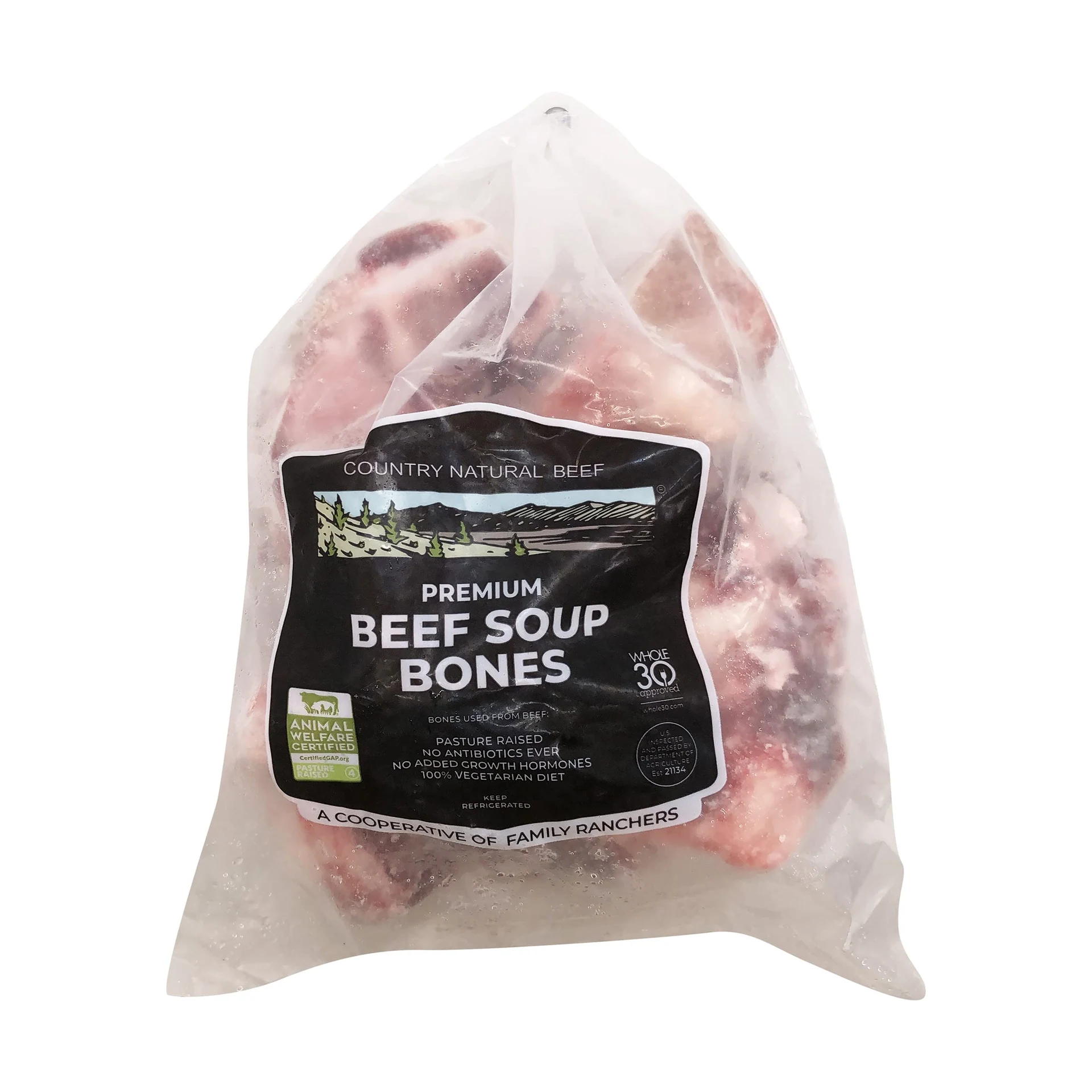
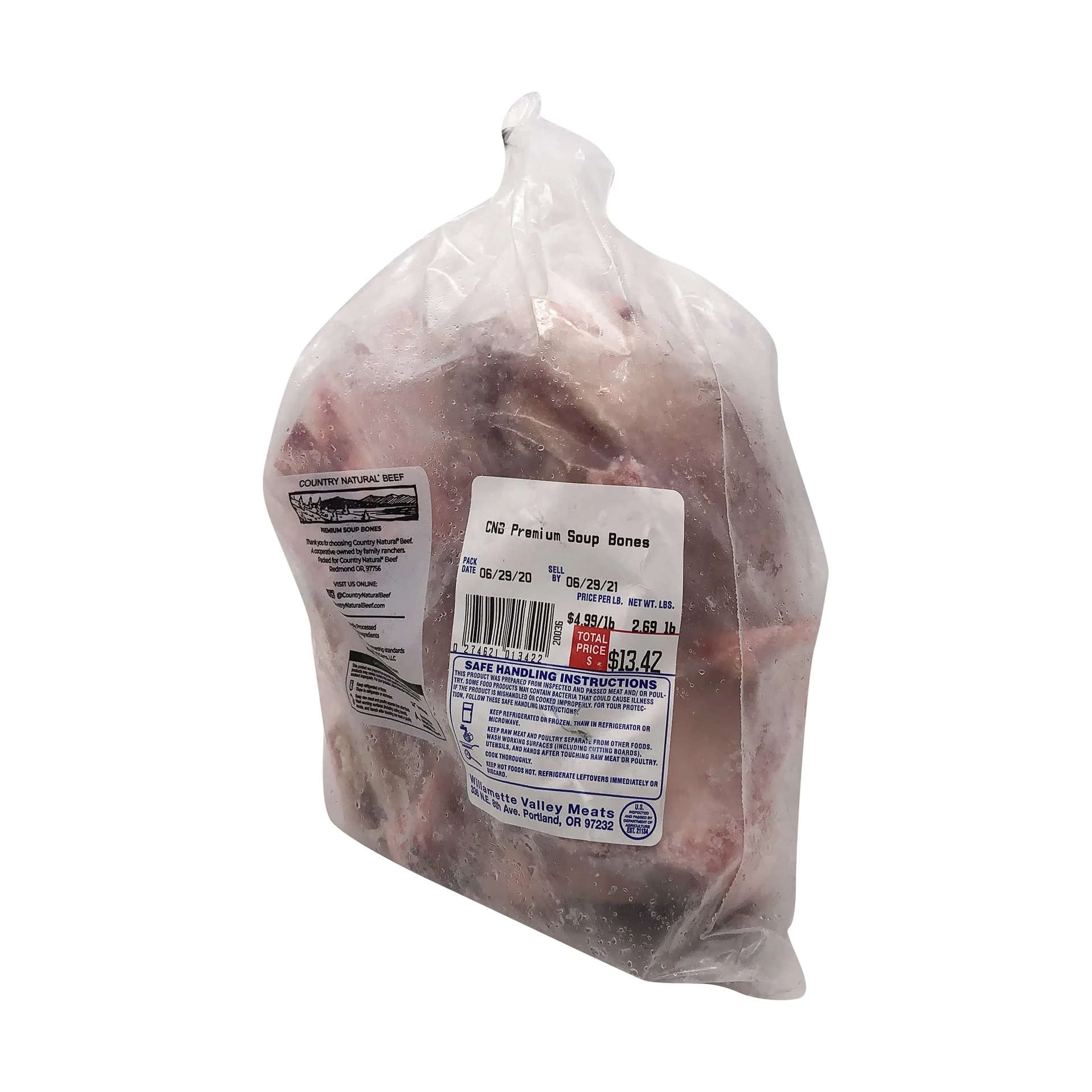
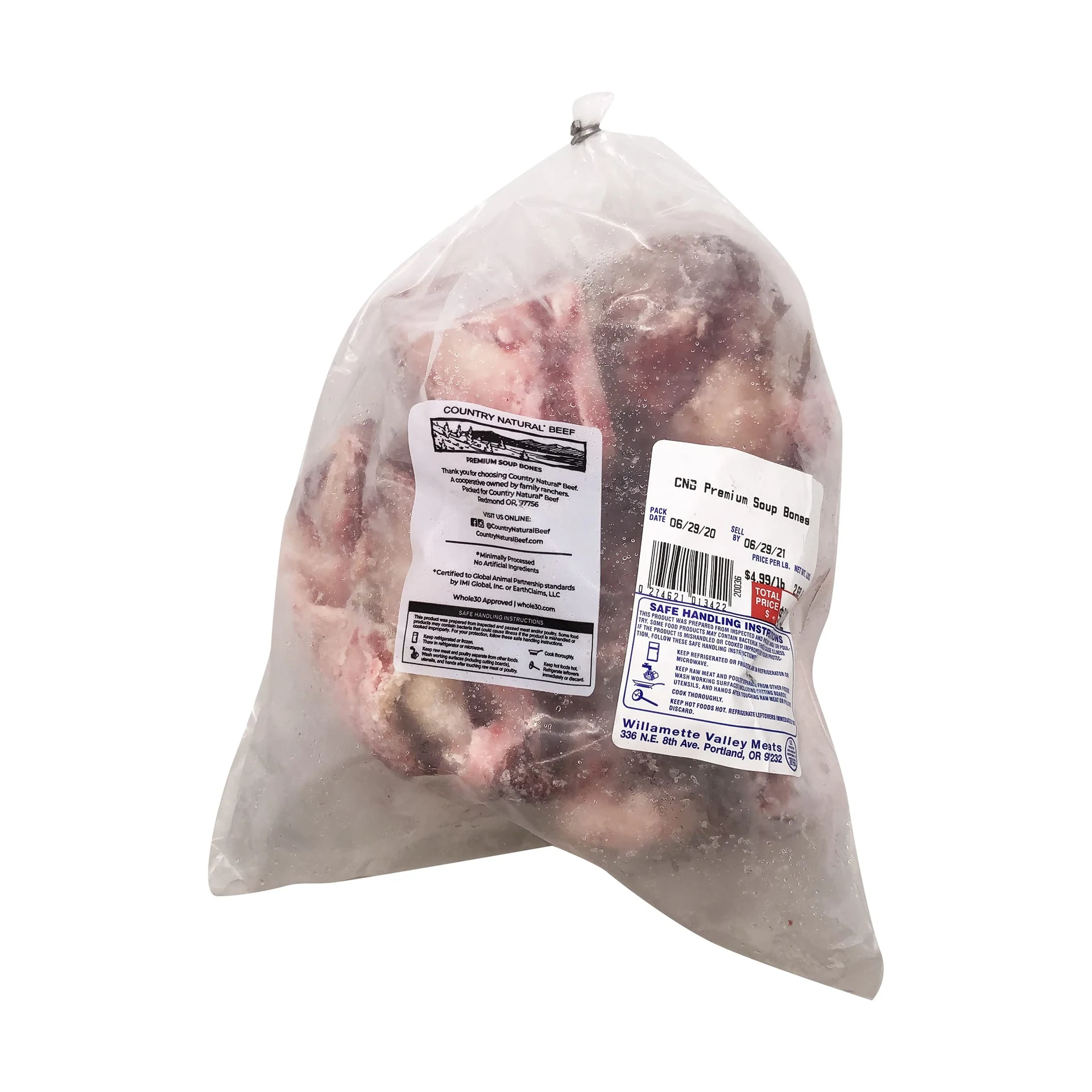
Product images · Packaging may change
Country Natural Beef Beef Soup Bones
Pasture-raised, grain-finished beef soup bones. Willamette Valley Meat on the 2020 package.
Feed and finishing
Grain finishedCertifications
G.A.P. Animal Welfare Certified — Step 4Feed
Likely non-GMO feedA CLOSER LOOK
The food facts.
Negatives
Feed and finishingGrain finishedMediocre
Raised on pasture from birth, with grain added for finishing. Beef Northwest’s Northwest Pasture Beef operation is a named pasture-based finishing partner. The exact grain mix and finishing duration are not specified.
More info
Mediocre
Raised on pasture from birth, with grain added for finishing. Beef Northwest’s Northwest Pasture Beef operation is a named pasture-based finishing partner. The exact grain mix and finishing duration are not specified.
Producer programme and named-network evidence retain their scope; no independent health, carbon or lot-level result inferred.
Grain finishing supplies energy-dense feed for weight gain and marbling before slaughter. We would choose grass and forage for cattle. In beef comparisons, forage feeding generally produces more omega-3 fat and a lower omega-6 to omega-3 ratio.
Individual farm/animal records remain unassigned.
Whole Foods Meat standards
Whole Foods’ Meat-department standards exclude animal by-products in feed. Its processing standards also prohibit irradiation, meat glue and lean finely textured beef.
Retailer department eligibility, not a farm feed log or complete processing-aid inventory.
Sources
Positives
FeedLikely non-GMO feedGood
Likely non-GMO feed. Country Natural Beef named non-GMO among its brand attributes in its March 2026 RaiseWell announcement.
More info
Good
Likely non-GMO feed. Country Natural Beef named non-GMO among its brand attributes in its March 2026 RaiseWell announcement.
CNB-specific declared attributes, retained prior brand statement and an announced October2026 all-portfolio rollout support a qualified programme inference. This is not inherited solely from Oregon Country Beef or G.A.P.
Non-GMO feed excludes genetically engineered crops from the ration.
Actual October rollout/certificate by package not independently confirmed.
The older G.A.P. artwork does not establish GMO exclusion; no Non-GMO Project certification or feed assay is assigned.
Current native former CNB job/brand-description URL is404; that retained historical claim is corroboration, not a renewed successful source read.
Whole Foods Meat standards
Whole Foods’ Meat-department standards exclude animal by-products in feed. Its processing standards also prohibit irradiation, meat glue and lean finely textured beef.
Retailer department eligibility, not a farm feed log or complete processing-aid inventory.
Sources
Product information
Feed
Whole Foods Meat standards
Whole Foods’ Meat-department standards exclude animal by-products in feed. Its processing standards also prohibit irradiation, meat glue and lean finely textured beef.
Retailer department eligibility, not a farm feed log or complete processing-aid inventory.
Sources
How it's raised
Finishing location · Pasture
Pasture access during grain finishing is part of CNB’s programme. Northwest Pasture Beef is a named finishing partner; the exact site and finishing duration for this pack remain unconfirmed.
Pasture access and grain feeding coexist; the named pasture-finishing operation supports this programme location answer, not an allocated ranch or grain-free finishing claim.
Actual pack-specific site, duration and current certificate remain unassigned.
Commercial pasture-based feedlot language does not establish confined-yard finishing.
Pasture required by G.A.P.
This G.A.P. cattle standard requires at least three-quarters of life on pasture when conditions permit. Seasonal and extreme-weather removal is allowed; removal for finishing is not.
The identified certification establishes a minimum pasture requirement. It does not establish uninterrupted year-round occupancy, grass-only feeding or actual performance beyond the standard.
Certification is a program requirement, not this animal’s attendance log.
Sources
- G.A.P. cattle standard v1.2 · §7.1.1–7.1.2; §7.3
Slaughter welfare audits · Animal-welfare audits required at slaughter
Whole Foods requires animal-welfare audits at slaughter for its beef supply. This is a retailer requirement, not a current audit result for this package.
Explains programme requirements or permissions; no actual animal procedure, journey, audit result or new practice rating assigned.
Sources
- Whole Foods Meat-department quality standards · Our Baseline Standards: welfare audits at slaughter
Animal transport rules · 16-hour baseline; longer rest-depot routes permitted
G.A.P. beef v1.2 normally limits Step 4 transport to 16 hours. Welfare exceptions and certified rest-depot routes under v2.0 allow longer journeys. These explain the listed tier; this product’s actual journey is unconfirmed.
Explains programme requirements or permissions; no actual animal procedure, journey, audit result or new practice rating assigned.
CNB announced a RaiseWell rollout beginning October 2026; actual current certificate and package transition remain unconfirmed.
The soup-bones photo is dated June 29, 2020. These explain the current listing’s Step 4 claim under the later standard; they do not assign 2022 rules to the pictured 2020 animals.
The rest-depot overview states 48 hours for two legs; section 2.B.1 states 40. Rare three-leg routes have separate conditions. No universal 16-hour end-to-end guarantee.
Sources
- G.A.P. beef v1.2 transport rules · 10.4, printed pp. 23–24
- G.A.P. Rest Depots v2.0 — October 1, 2025 · Overview printed -1 (physical 2); 2.A–2.C printed 3 (physical 8)
Step 4 physical procedures · Castration and early disbudding permitted
G.A.P. beef v1.2 Step 4 permits farm castration before three months and disbudding before six weeks; hot-iron disbudding requires short-term pain relief. Older castration requires a veterinarian and long- and short-term pain relief. Actual procedures are unknown.
Explains programme requirements or permissions; no actual animal procedure, journey, audit result or new practice rating assigned.
CNB announced a RaiseWell rollout beginning October 2026; actual current certificate and package transition remain unconfirmed.
The soup-bones photo is dated June 29, 2020. These explain the current listing’s Step 4 claim under the later standard; they do not assign 2022 rules to the pictured 2020 animals.
Specified methods and veterinary exceptions apply; actual farm procedure and pain-relief records remain unallocated.
Sources
- G.A.P. beef v1.2 procedure rules · 5.5–5.6, printed/physical pp. 11–12
Antibiotics & hormones
No antibiotics
Excellent
No antibiotics
Routine antibiotic use can select for resistant bacteria. A no-antibiotics supply commitment keeps treated animals out of that programme; sick animals still need care.
Raised without antibiotics. Limiting routine antibiotic use helps reduce selection for antibiotic-resistant bacteria. Sick animals can still receive care and be kept out of this supply.
No added hormones
Excellent
No added hormones
Added growth hormones accelerate weight gain. We would choose meat raised without that intervention.
A no-added-hormones commitment excludes hormone treatments used to accelerate weight gain.
Certifications
Certifications · G.A.P. Animal Welfare Certified — Step 4 (dated source)
G.A.P. Step 4 is shown on the June 29, 2020 package. The current listing also names Step 4. CNB announced a RaiseWell rollout from October 2026; current issued coverage for this product remains unconfirmed. G.A.P. Step 4 is shown on the historical product-package photograph.
Keep the advertised welfare tier visible without assuming a current issued replacement certificate or measured farm outcome.
Historical2020picturedpack; current retailer title is not a received lot or issued current certificate.
Origin & producer
Related businesses
Ranch cooperative · Dement, DeFrees, Dunham, Ditto Creek and Pratt
Cooperative members include Dement, DeFrees and Dunham ranches in Oregon, plus Ditto Creek and Pratt in Idaho. These are network members; this package’s supplying ranch is unassigned.
Country Natural Beef publishes a directory of its cooperative ranch families. Membership identifies a real sourcing network, not the individual ranch supplying this package.
Program context does not identify a current retail lot, supplying farm or certificate.
Sources
Raising origin · Likely U.S.-raised
Likely U.S.-raised. CNB’s cooperative has ranch members across nine U.S. states and describes pasture raising from birth. The exact ranch supplying this package is unassigned.
Named U.S. cooperative membership and the birth-to-finishing programme support likely U.S. raising, without establishing birth/slaughter country or individual package custody.
No package-specific ranch/animal custody recovered.
This is a visible inference; categorical raising country remains unselected.
Pictured processor · Willamette Valley Meat (2020 package)
Willamette Valley Meat in Portland, Oregon processes/packs the pictured package (EST. 21134). The pictured pack date is June 29, 2020. This does not identify the cattle’s ranch or upstream slaughterhouse.
The establishment mark identifies processing for the pictured version, not the supplying ranch or slaughterhouse.
A different current package requires its own establishment match.
No current specific wash, atmosphere or site outcome is assigned from the processor identity.
An unknown answer does not mean “none.” Check your package for current details.
KEEP EXPLORING
Also in the meat aisle
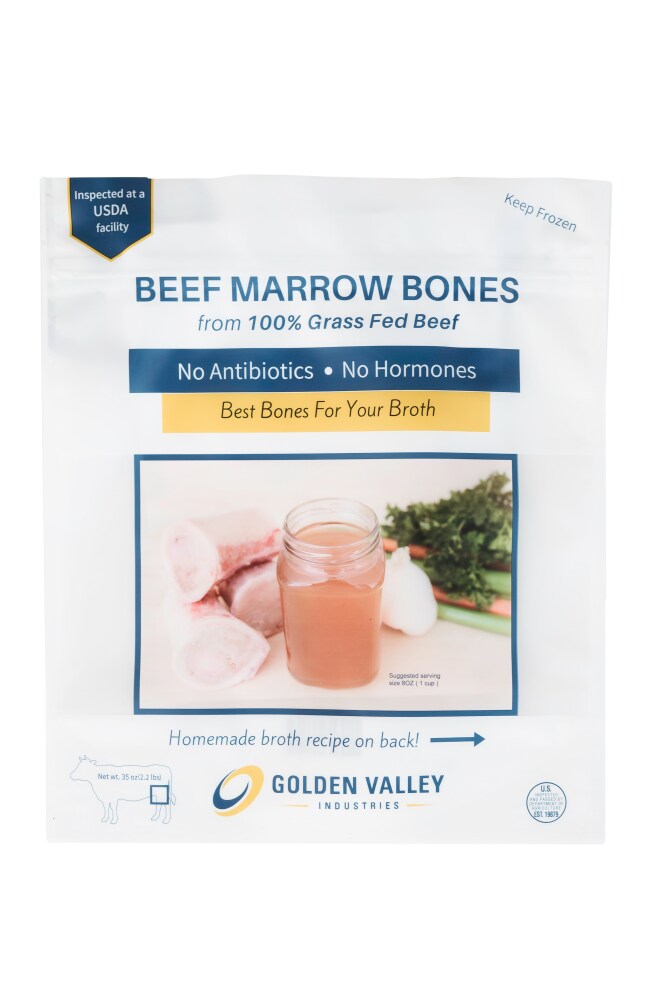
GVI
GVI Grass-Fed Beef Marrow Bones
- 100% grass-fed
- 100% grass-fed
- Processed in
- Modesto, California, United States
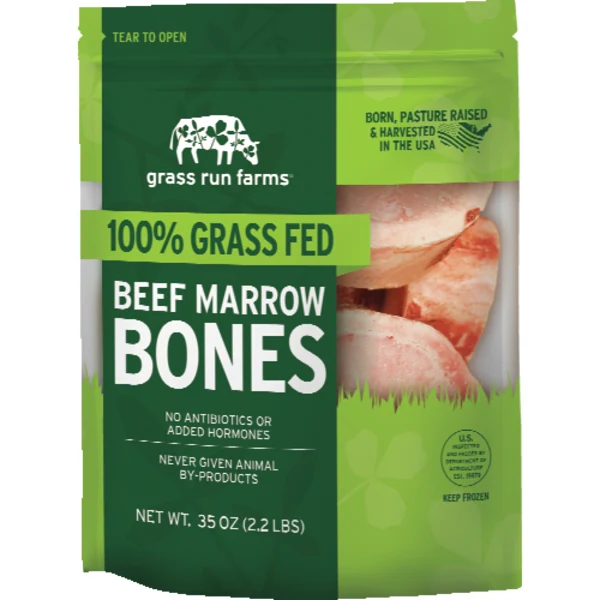
Grass Run Farms
Grass-Fed Frozen Beef Marrow Bones
- Feed
- 100% grass-fed
- Origin
- United States
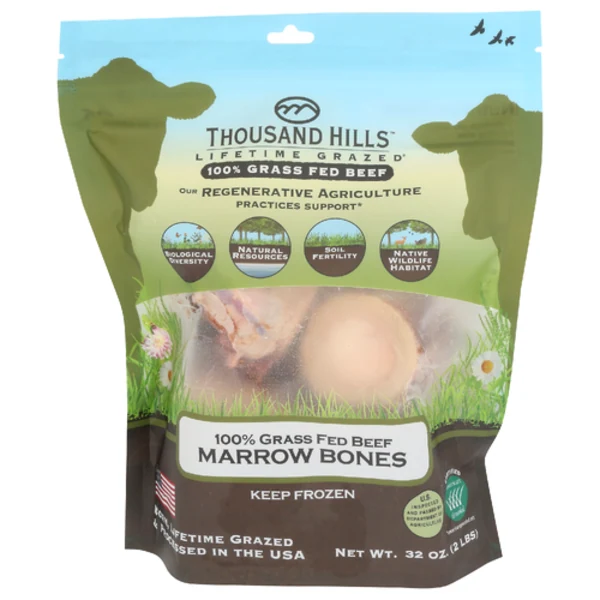
Thousand Hills
100% Grass Fed Beef Marrow Bones
- Feed
- 100% grass-fed
- Origin
- United States